
At Congress 2022, a panel organized by the Canadian Society for the Study of Education gathered to discuss an upcoming anthology, Global Perspectives on Microaggressions in Higher Education: Understanding and Combating Covert Violence in Universities (Routledge, 2023).
Christina Page opened the conversation by discussing her study: “Linguistic Racism, Deficit Constructions, and the Othering of International Students”. Soon to be published in Chapter 3 of the volume, Page’s study discusses how an international student’s way of speaking can invite bias and discrimination, even if their English is clear. My father was an international student in the 1970s and could barely speak English at all, so these conversations are close to my heart.
Stephanie Speicher contributed the thirteenth chapter, “The Use of the Reflective Personal Narrative to Mend Microaggressions and Microinsults of the Preservice Teacher.” In her presentation, Speicher provided the template for a suggested assignment for use in other universities and departments. Near the beginning of a term, students can construct personal narratives based on the theoretical structure provided in the diagram below.
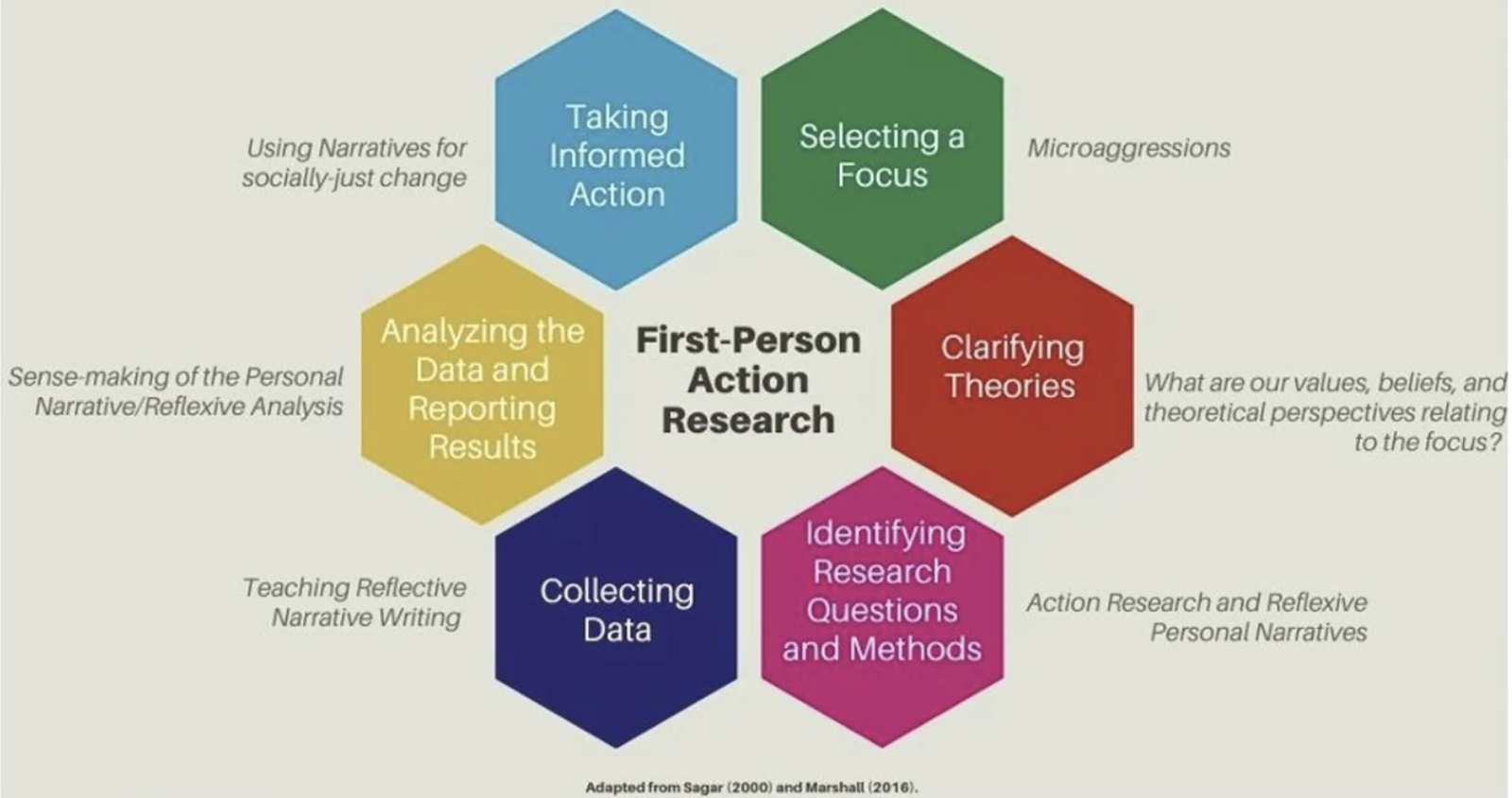
Speicher mentioned that students found conversations about social justice to be difficult, creating the need for extra support from the faculty. Once students had written their narratives, they formed small groups with their peers to discuss what they had learned about themselves through the assignment. Speicher shared some profound, emotional insights. One student had not realized her hurtful behavior towards others until she stopped to consider her interactions. Our automatic thought patterns become so ingrained that it takes intentional reflection to understand how microaggressions perpetuate.
All of the speakers packed plenty of information into the hour. To discuss Chapter 11, “Confronting Microaggressions Within and Beyond the Academy: Narratives of an Anti-Racism Network,” Kamal Arora, Adrienne S. Chan, and Awneet Sivia shared the floor. I appreciated the idea of a space where people could go to find support if they were a victim of microaggression. The researchers pointed out that often, students cannot go to the teacher, because the teacher permitted the inappropriate behaviour in the first place.
As long as racism is protected under academic freedom, and human rights committees are contained within university administrations, rather than an impartial third party, institutions have a long way to go before they can solve the problem of microaggressions. The presentation inspired me to believe that change is possible. Creating safe spaces and exercises to address implicit bias have made a difference. More institutions need to follow suit.
Sima Chowdhury is the author of Mindful Meditation available on Amazon and is a social work student at the University of Manitoba.

Semaine du libre accès 2026
Trousse promotionnelle de la Subvention du livre savant
Aidez-nous à faire connaître la Subvention du livre savant Travaillez-vous avec des auteur.trice.s, des chercheur.euse.s, des éditeur.trice.s ou d’autres acteur.trice.s du milieu de l’édition savante dans les domaines des sciences humaines? Aidez...

Un kilomètre carré. Une autre vision de l'université
← Page d'accueil du balado Voir Grand Introduction | À propos des invitées | Retranscription | Suivez nous Introduction Une université n’est pas seulement un campus; c’est aussi un lieu qui fait partie d’un quartier, un lieu qui côtoie ses...