

Introduction | About the guest | Transcript | Follow us
Introduction
As Canada looks to assert its role as a leader in research and innovation, a key question arises: what place is given to research conducted in French, particularly outside of Quebec? Although they are too often overlooked, Francophone minority communities play a crucial role in the development of knowledge and Canadian identity.
In this month’s episode of the Big Thinking Podcast, Karine Morin is joined by Émir Delic, Dean of Faculties and College Studies at Université Sainte-Anne. Together, they explore the impact of Francophone research outside Quebec, its challenges, its contributions, and its potential for the future
About the guest
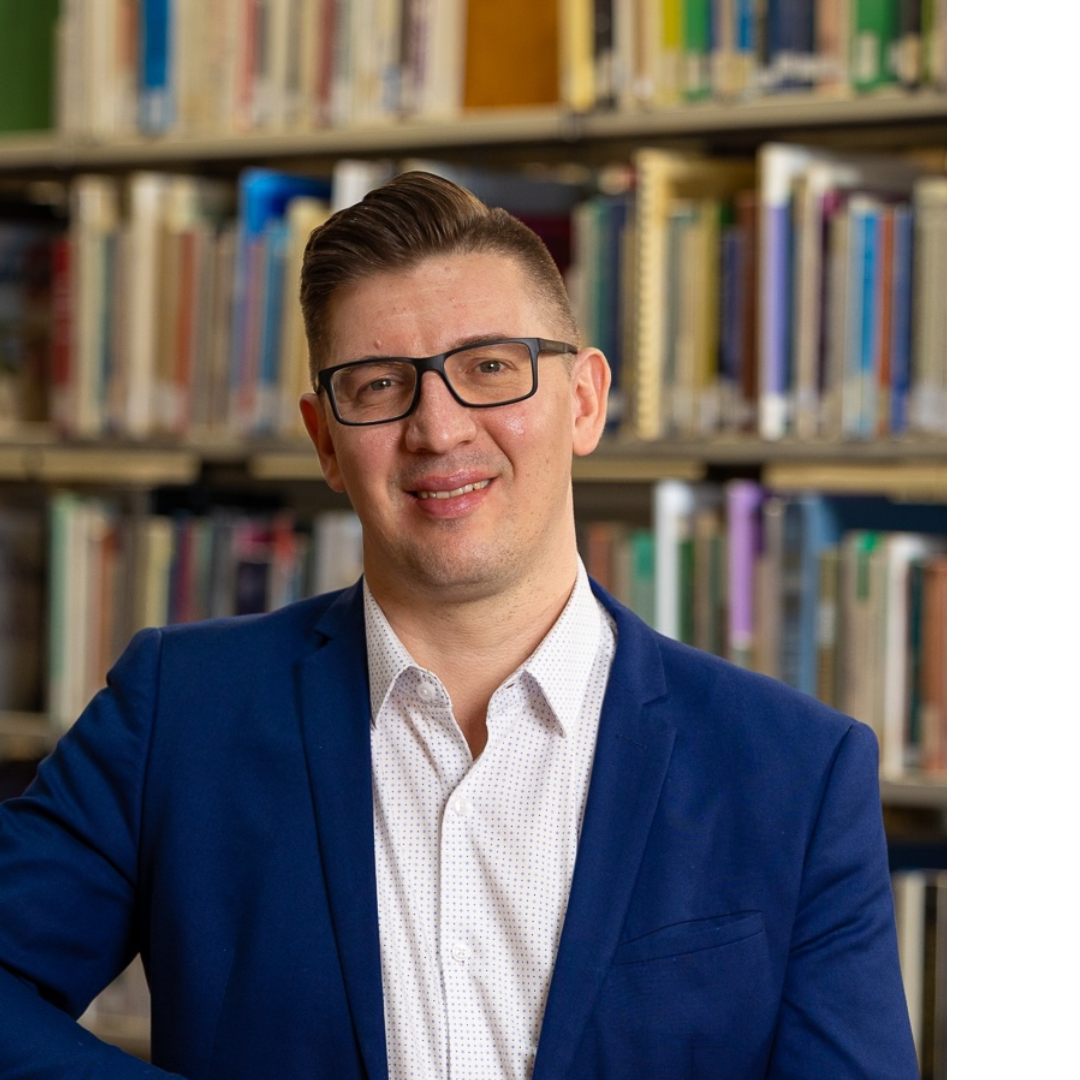 Emir Delic, Ph.D., joined the faculty of the Department of French Studies at Université Sainte-Anne in 2014. He became the department chair in 2020 before serving as associate dean of academic affairs from 2021 to 2025.
With a personal and professional background rich in intercultural experiences, he has lived and breathed the Canadian Francophonie for over 25 years. This is reflected not only in his daily life and teaching—first in French-speaking Ontario and then in Acadia—but also in his research. A specialist in the literature of Canada’s Francophone minority communities, he is particularly interested in individual and collective representations of self among marginalized groups, a topic to which he has dedicated numerous scholarly publications.
Upon his arrival in Baie Sainte-Marie, he drew on the diverse experience in teaching, research, and academic administration he had accumulated in various academic settings (Waterloo, Saint-Jérôme, Nantes, Ottawa) to play a leading role in a variety of community service initiatives. As Vice Dean, he facilitated curriculum planning, the implementation of new administrative structures, and the development of educational partnerships, including the innovative dual-degree program leading to a Master’s in French as a Foreign Language (FLE) and Business (B.A.). Ed.
His inspiring leadership, centered on collegiality, integrity, and strategic vision, is recognized beyond the university setting, as evidenced by his diverse engagements with government agencies and regional, national, and international organizations. For instance, between 2014 and 2021, he edited the “Francophone Canadian Literature and Culture” collection for the digital reference work The Literary Encyclopedia (London); in 2022 and 2023, he served on the Evaluation Committee for the Dimension: Equity, Diversity, and Inclusion Canada program; and in 2025, he was Vice President of the Canadian Studies Network.
[00:00:06] Karine Morin: As Canada looks to assert its role as a leader in research and innovation, a key question arises: what place is given to research conducted in French, particularly outside Quebec?
[00:00:20] Although they are too often overlooked, Francophone minority communities play a crucial role in the development of knowledge, culture, and Canadian identity.
[00:00:30] My name is Karine Morin, and I am the President and CEO of the Federation for the Humanities and Social Sciences. For this episode of the Big Thinking Podcast, I’m joined by Émir Delic, Dean of Faculties and College Studies at Université Sainte-Anne in Nova Scotia.
[00:00:49] Together, we’ll explore the impact of Francophone research outside Quebec, its challenges, its contributions, and its potential for the future.
[00:01:00] Émir Delic, hello. It’s a great pleasure to have you on this episode of the Big Thinking Podcast. I should tell our listeners that we already know each other a little, since a few years ago, we collaborated on a major federal initiative on equity, diversity, and inclusion.
[00:01:19] But today, we’re focusing on somewhat related issues, specifically linguistic identity. So my first question for you: what led you to pursue an academic path in a Francophone context outside of Quebec? Is there a particular story you’d like to share?
[00:01:38] Émir Delic: Well, thank you very much for having me today; it’s a great pleasure to be here with you. Yes, so at the end of high school, I was very torn about what to study next—I was going to either study theoretical math or French. So, two very different paths.
[00:02:00] And what led me to choose the path of French studies—which was really the start of my professional journey—was a provincial French competition organized at the time by the University of Waterloo. This was significant for me in several ways; not only did this competition allow me to meet professors who were themselves working in a minority context—that is, in southern Ontario and in French—
[00:02:34] But it also allowed me to envision a future where I could continue my studies in French, because obviously, if I had made the other choice, I would have studied math and theoretical s at the University of Waterloo as well, but in English. So it was really a combination of circumstances, in many ways, that led me to choose an academic path and, later, a professional career in French.
[00:03:00] Karine Morin: And then, once that choice was made, you worked in various settings within the Canadian Francophone community: first in Ontario and, for the past few years, in Acadia.
[00:03:03] Is there a particular moment that illustrates the intellectual and professional mindset required to study, teach, or conduct research in French outside of Quebec?
[00:03:27] Émir Delic: I firmly believe that you need to be surrounded by—and surround yourself with—people who share the same passion for the Francophonie and the Francophone cause in Canada, because, in my view, this generates a vibrant energy that drives and inspires us.
[00:03:49] So at that time, many of us were concerned about the fact that we were at the university, including within the student union, which tried to have the French language proficiency requirements removed for positions on the Board of Directors.
[00:04:05] Even though we didn’t really know each other very well, we were so committed to our cause that we quickly organized to counter this misguided move. It’s a curious fact, but one that also, I think, speaks to the importance of surrounding yourself with colleagues in a Francophone minority context.
[00:04:22] Almost all the members of that small group at the time—we were just a little band—are still active today, each in their own way, within the Canadian Francophone community.
[00:04:33] In short, as Homer said, if my memory serves me right, “Heaven always brings together those who are alike.” Still, when we make our home in a French-Canadian minority community, we must be willing to embrace, day by day, the rich contribution of this affinity so that our commitment to the Francophonie and to studies and science in French in a minority setting can flourish.
[00:05:00] Karine Morin: So, I’m getting to the point of asking, particularly for students, in your opinion, what is the challenge of choosing to continue studying in French, especially outside Quebec?
[00:05:38] Émir Delic: I think it’s a choice that requires a great deal of thought because when we make it—and very often, when we think about our future—we tend to focus on career opportunities and the profession we’d like to pursue at some point.
[00:05:57] And it is now a well-established fact that the variety of French-language programs, especially outside Quebec, is more limited. So, I would say that this variety decreases as we progress through our studies. In other words, among the 22 post-secondary institutions outside Quebec, many offer undergraduate programs, a smaller number offer graduate programs, and an even smaller number offer doctoral programs.
[00:06:33] So, first of all, I would say there’s the issue of program availability, and I need to point out something I sometimes hear in these circles: “But there’s always Quebec,” “We can always go study in Quebec.”
[00:06:48] I would say that this is a false solution for many people: among other things, there are the challenges people face when they arrive in Quebec—not only being far from their families, but also the issue of language insecurity, which is very often mentioned and should not be underestimated.
[00:07:11] So, there is the availability of educational opportunities, I would say, but there is also the fact that many people want to stay in their community and remain engaged in their community. And when, on the other hand, the time comes to make the difficult decision, they simply choose English because, precisely, the French-language program isn’t offered.
[00:07:36] Karine Morin: So that was from the perspective of the choices students make. If we look at researchers, in your opinion, what are the challenges of an academic career in French outside of Quebec?
[00:07:53] And particularly in terms of research opportunities, national or international collaboration, recognition, and funding, how do things work out for Francophone researchers outside Quebec, like yourself?
[00:08:08] Émir Delic: Well, one of the key points—one of the critical moments that poses an obstacle, which we just mentioned earlier—is the transition from high school to post-secondary education. When the time comes to decide whether, as a young doctor, you want to work in a French-speaking minority setting, it’s a very personal choice.
[00:08:45] First, there’s the issue of job availability. So, when you think about the number of French-language or bilingual institutions—or even French-speaking campuses—that are available and where you could work, there aren’t very, very many.
[00:09:03] Some researchers also choose to work at English-language institutions, which presents its own set of challenges. But regardless of the environment chosen, conducting research in French outside of Quebec requires favorable conditions.
[00:09:23] So in French-language institutions—if one is fortunate enough to work at one of these institutions—these institutions have suffered for years from chronic underfunding, which means that when there are budget deficits, we very often have to deal with a reduction in regular faculty positions that combine research, teaching, and community service; and, as a result, the next generation of researchers ends up filling positions focused on teaching, which, in turn, undermines our research capacity and, at the same time, the vitality of Francophone research.
[00:10:05] Once someone holds a full-time position at a university outside Quebec, other challenges arise. For example, there is the issue of disseminating research in French.
[00:10:23] We know very well that English-language journals are generally more numerous, offer greater visibility, have a wider distribution network, and carry a more significant impact factor.
[00:10:40] Therefore, to give themselves the best possible chance, many Francophone researchers make a very conscious choice to publish in English. When we then consider funding opportunities, similar challenges arise. For the past few years, we have been fortunate to have access to a French-language research support service provided by Acfas.
[00:11:06] That said, this one-time service only solves part of the problem for these researchers. Why? Because when it comes time to evaluate their applications, there are criteria used that, very often, do not sufficiently take into account the reality of researchers at these institutions.
[00:11:32] The third factor to consider—and perhaps the one least frequently considered in funding opportunities—is the opportunity to train the next generation of researchers. So, as I mentioned earlier, there aren’t many institutions that can rely on a large number of graduate students serving as research assistants who can be trained in research.
[00:11:56] And this, too, is a factor that is very often viewed unfavorably when evaluating applications from researchers working in Francophone minority communities. So I’ll limit myself to these three obstacles for researchers.
[00:12:14] Karine Morin: And these are all significant obstacles, obviously. Before we go any further, we should still give our listeners some context. You are at the Université Sainte-Anne in Nova Scotia.
[00:12:26] And I have to say that I’ve only known this institution for a few years, even though it’s been around for well over 100 years. Can you tell us a little about the role of this university within Acadia, within the Acadian community? What sets it apart from other institutions in Nova Scotia or even from institutions in the other Maritime provinces?
[00:12:45] Émir Delic: So anyone looking at Université Sainte-Anne from the outside—as I myself did about fifteen years ago —that is, anyone unfamiliar with its history, mission, or facilities—gets the impression that it is a post-secondary institution like any other: it educates enlightened citizens, ready to enter the workforce or continue their studies, and it creates and disseminates knowledge, with the exception that it all takes place in French.
[00:13:15] However, I can tell you right now that appearances are deceiving. So, to fully appreciate the importance of the institution’s educational mission, I’d like to take a brief historical detour: the University was founded in 1890 by a congregation of Eudist fathers.
[00:13:35] And it was initially a classical college, named Collège Sainte-Anne. And for over 70 years, the Eudists managed to remain faithful to their original mission: that is, to protect the language and the faith, as the saying goes. And to do so, they offered Acadians— —an education that was rigorous, certainly, but an education that equipped them to free themselves from their status as outcasts.
[00:14:00] And that is indeed the word used in an official brief submitted to the government in the late 1960s—a few years before the institution became public; it became public in 1971.
[00:14:15] And this report points out that, prior to the College’s founding in 1890, Acadians were absent from the ranks of the liberal professions, and we know full well that it is these professions that constitute what is known as a society’s elite.
[00:14:32] In other words, before the College was founded, there wasn’t a single doctor, not a single lawyer, not a single teacher who had been entirely trained in French-speaking Nova Scotia; yes, people were trained elsewhere and then came to settle in Nova Scotia. So in addition to this educational mission, Université Sainte-Anne, like other small Francophone institutions, is truly a hub of vitality for the local and regional community.
[00:15:06] For example, our main campus in Pointe-de-l'Église provides essential living and social spaces for the community; so, whether it’s the swimming pool, the sports field, the ice rink, or the theater, all these facilities are shared with the municipality.
[00:15:22] In fact, a few months ago, we even signed an agreement with the municipality to become the first “university municipality”—not a “university town,” but a “university municipality”—in order to deepen the synergy we’ve had for years between us and the community.
[00:15:42] This social mission is also reflected in the presence of several campuses; we have the main campus located in Pointe-de-l'Église, by the sea, but we also have satellite campuses in other Acadian regions of the province: so, there is a campus in Tusket, a campus in Halifax, a campus in Saint-Joseph-du-Moine, and another in Petit-de-Grat.
[00:16:08] Karine Morin: Could you give an example of the connection between university, research, culture, and community? Are there any examples that come to mind that you could share regarding this alignment of research, culture, and community?
[00:16:27] Émir Delic: Absolutely. I think that research conducted in minority communities, such as the one at Université Sainte-Anne, is essential both for understanding these communities—since many of our researchers work, of course, in research areas of interest to the communities, meaning our local community, but also, more generally, French-speaking minority communities, and they also work on research that concerns the world.
[00:17:06] So what needs to be emphasized, in my opinion, is that research conducted in French is not the same as research conducted in English and then translated into French. I think this aspect is sometimes overlooked, because we seem to forget that mastering another language isn’t simply about mastering another mode of communication; it’s also, above all, in my opinion, about integrating into another culture and, through that, acquiring a different way of understanding reality, of perceiving the world, of seeing, and of perceiving oneself
[00:17:41] And that is why I think it is not at all uncommon for polyglots to adopt a slightly different personality depending on the language they are speaking.
[00:17:49] Karine Morin: So, based on what you’ve just told us, regarding this situation of education or research in French-speaking minority communities, what should the public—the general public—and future students understand? And above all, what should provincial and federal policymakers take away regarding the importance of institutions such as Université Sainte-Anne?
[00:18:19] Emir Delic: Research emerging from Francophone communities on the margins is by no means marginal; on the contrary, it is central to understanding today’s world. Why? Because, in my view, this research plays an essential role in the development of science in our country and, therefore, in the advancement of our society.
[00:18:41] If I had to highlight just one aspect in this context, I would emphasize that Francophone minority communities possess knowledge—and valuable knowledge—about the key issues facing our country.
[00:18:59] For example, a highly topical issue today is how to survive under precarious, and uncertain living conditions; how to maintain a heritage or culture largely absent from public spaces and fraught with tensions of all kinds that threaten its very existence, yet which, at the same time, are enough to drive these communities to draw on their inner strength to persevere, adapt, and evolve.
[00:19:31] In many ways, Canada’s Francophone minority cultures, which have long had to contend with asymmetrical power dynamics, have forged ways of doing things, ways of being, and ways of living with others rooted in resilience.
[00:19:48] Thus, more than one diaspora culture, and more than one vulnerable community, whatever it may be, could draw on the knowledge of resilience found within Canada’s Francophone minority communities.
[00:20:03] That is why, from the outset, research emerging from the Franco-Canadian margins proves invaluable. Indeed, in addition to being a cornerstone of the project to achieve true equality for Canada’s two official languages, it constitutes a rich resource for the knowledge society and intellectual life in the country.
[00:20:26] Karine Morin: Everything you just said reminds me of the work we did together when we collaborated on an initiative addressing issues of equity, diversity, and inclusion that didn’t touch on linguistic perspectives.
[00:20:40] But in your view, how do structural language barriers resemble or differ from other barriers related to identity factors?
[00:20:51] Emir Delic: That’s a very interesting question, and also a bit of a delicate one. So I’m going to try to choose my words carefully to avoid any misunderstandings, but it’s a very good question you’re asking.
[00:21:12] So I think we need to recognize that there are points of convergence and points of divergence between initiatives that specifically target Canada’s Francophone and minority communities and groups seeking equity.
[00:21:29] So, a convergence is possible, but I think this convergence must be analytical and contextual in order to be enlightening. So, as for the points of convergence, there is, to begin with, of course, minority status, which is based on asymmetrical relationships with power structures.
[00:21:51] Along the same lines, we might consider unequal access to social services—whether in education, healthcare, or the justice system. We could also point to the underrepresentation of members of these various groups within decision-making bodies. So that is a first point of convergence.
[00:22:12] A second point of convergence, in my view, concerns efforts to address systemic inequity through institutional mechanisms—such as legal frameworks, various policies, and targeted programs.
[00:22:32] A third point of convergence—and this one is truly interesting, in my view—is the issue of intersectionality. I think that for a very, very long time, we didn’t consider intersectionality when looking at Canada’s Francophone minority communities, but there are indeed intersectionality issues at play.
[00:22:52] Why? Because we sometimes overlook the fact that these communities—that is, Canada’s Francophone minority communities—are not homogeneous groups; they have never been homogeneous groups.
[00:23:06] So there may be people living in these communities who have multiple heritages, multiple affiliations. The same goes for groups seeking equity; one can belong to multiple groups. So I would say there are these three major points of convergence when considering comparisons.
[00:23:31] As for the points of divergence, these must also be highlighted. So, a first point of divergence, in my view, concerns the nature of the criteria or identity traits that define belonging.
[00:23:40] Generally speaking, Francophone minority communities are defined by language and culture; in contrast, membership in groups seeking equity is very often based on broader characteristics: so here we’re thinking of sex, gender identity, and sexual orientation, racial or ethnic identity, or disability.
[00:24:06] A second point of divergence concerns the specific constitutional status of these groups—that is, Francophone minority communities. As we know, these communities have institutional collective rights, such as official bilingualism and their own institutions.
[00:24:28] On the other hand, when it comes to groups deprived of equity—with the exception of Indigenous peoples—these groups, in fact, rely primarily on human rights. They rarely have collective rights, with the exception of Indigenous peoples, and they do not really have institutions of their own. So, for me, this is a second very important point of divergence.
[00:24:53] And the third point of divergence—and here again, Indigenous peoples are an exception—is the territorial dimension. Canada’s Francophone minority communities are very often tied to a territory with strong historical roots; even if that territory isn’t clearly defined—you can never draw Acadia on a map—we know exactly where the various Acadian communities are located.
[00:25:23] On the other hand, groups seeking equity are always cross-cutting; they are found in every territory, in every community. So, if I emphasize these differences, it is because, for example, one can belong to a Francophone minority group without belonging to one of the groups deprived of equity.
[00:25:48] Now, the reason I wanted to offer a word of caution is that there are always risks—there are risks, but also benefits—to these kinds of alliances.
[00:26:04] A major risk—and I think the one that underlies the reluctance of certain Francophone minority communities toward such alliances—is the reduction of Francophone minority communities to just another group deprived of equity. So that, I think, is actually a well-founded reluctance.
[00:26:28] Another dimension that, in my view, poses a risk with these alliances is the tendency to fall into a kind of opposition and competition between minority groups. That said, we must not underestimate the benefits of these alliances. These alliances can enable us to gain a better understanding of the dynamics of inequality
[00:26:57] So because these different groups experience, each in their own way, the pressures to conform that I mentioned earlier, each group has developed certain tools of their own to assert themselves, to defend their rights, and to be recognized.
[00:27:21] And I believe there is a need to share this knowledge in order to dismantle the systemic oppression that these groups experience in different ways.
[00:27:33] Karine Morin: I see in this very, very detailed and nuanced response—which reflects a long and thoughtful consideration of a question that was indeed complex and delicate—that we might conclude by asking you to share one final idea with our audience.
[00:27:57] What should we understand regarding the importance of Francophone institutions outside Quebec for the future of research in Canada, regardless of identity, and not just for Francophone communities or minority communities, or in the pursuit of equity for Canada in all its diversity?
[00:28:17] Émir Delic: At the risk of repeating myself, I would simply say that the research, studies, and education taking place at French-language universities and campuses serving minority communities are essential to understanding today’s world and to the advancement of science in French, both in Canada and internationally.
[00:28:43] Karine Morin: Well, that’s well said, and above all, thank you, Émir Delic, for this wonderful interview.
[00:28:50] Émir Delic: Thank you very much
[00:28:58] Karine Morin: Thank you for listening to the Big Thinking Podcast, and thank you to our guest, Émir Delic. I’d also like to thank our friends and partners at the Social Sciences and Humanities Research Council, and the production company CitedMedia, without whom this podcast wouldn’t be possible.
[00:29:14] You can find all episodes on your favorite podcast platform. Let us know what you thought of this episode by connecting with us on social media. See you next time!

Spotify

Apple Podcast

Amazon Music

Podcast Addict

iHeartRadio
