

Introduction | Our recommendations | Conclusion
Advocating for HSS research funding in 2025
Ahead of the 2025 federal budget announcement, the Federation submitted a pre-budget consultation that contained four recommendations informed by our community. The humanities and social sciences (HSS) play a pivotal role in addressing the systemic social, technological, environmental, and cultural issues of our time. A strong research ecosystem provides the framework to challenge these issues, provide insights, and drive meaningful change for Canadians.
Despite this essential role, HSS disciplines continue to receive a disproportionately small share of federal research funding. To build a balanced and future-ready research ecosystem, the federal government must allocate at least one-third of research investments across the Tri-Agency and related national initiatives to the HSS.
Why this matters:
- The humanities and social sciences are one of the three core pillars of federal research funding, alongside natural and health sciences
- HSS disciplines account for a significant portion of Canada’s faculty, graduate students, and academic programs
- HSS research has a cross-cutting impact that influences the social, cultural, ethical, and institutional conditions that shape and drive inclusive innovation, while developing the talent and critical capacities needed to lead and sustain it
- Public confidence in HSS research remains strong (seven in ten Canadians supported federal investment in the HSS research during the 2008 financial crisis)
Our recommendations
1. Increase the share allocated to the HSS to at least one-third
Following an extended period of community engagement and consultations, the federal government announced funding increases for science, research, and post-secondary education in Budget 2024. These commitments, while openly welcomed, provide a temporary relief to a historically strained system. The federal government must address the structural underinvestment in the HSS to ensure that Canada’s research systems are equipped to meet national priorities.
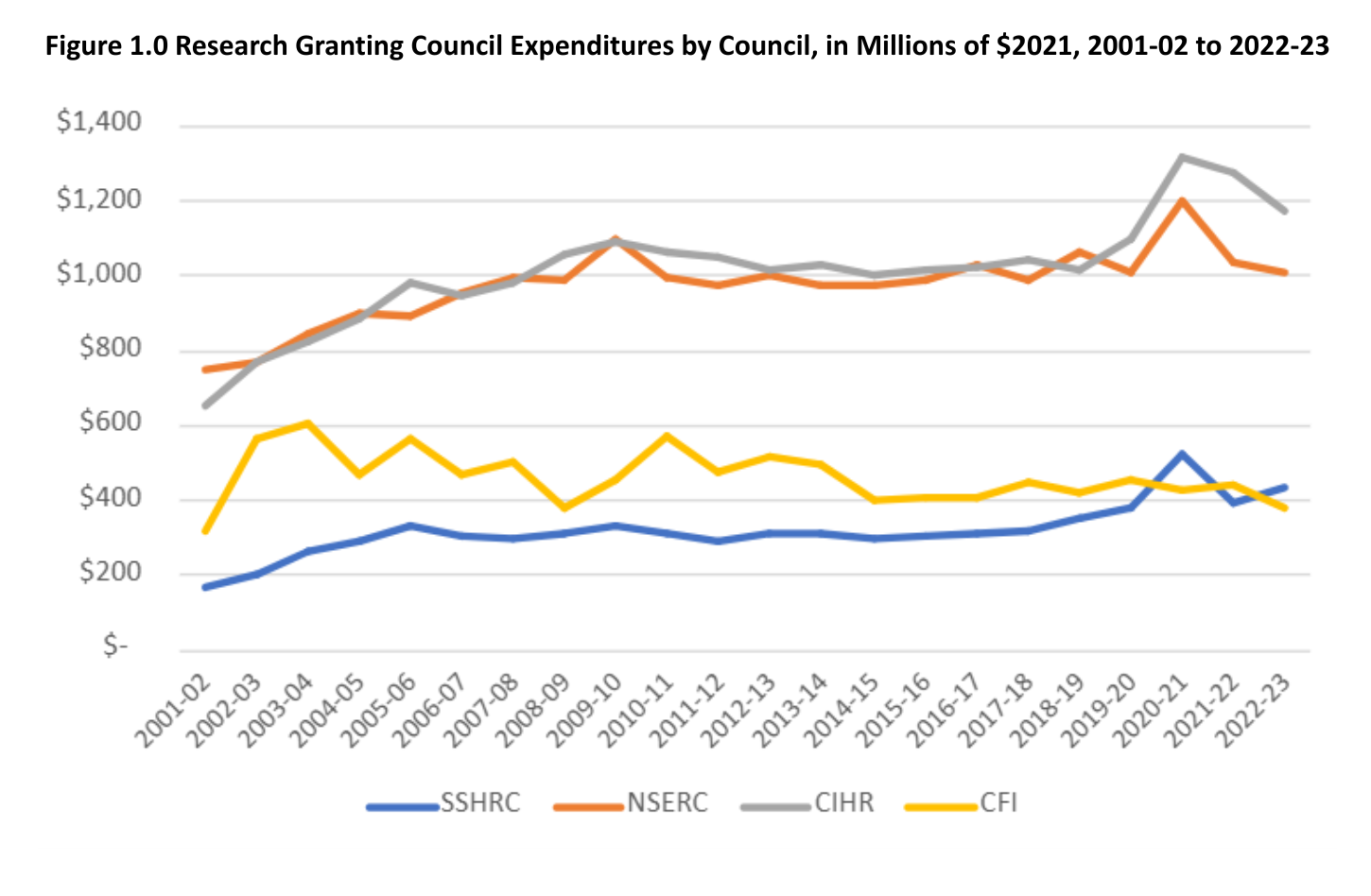
Federal granting council funding remained essentially flat from 2008–09 to 2018. Despite a modest increase in 2018, analysis indicates that inflation has since eroded most, if not all, of these gains, according to a 2025 environmental scan by Higher Education Strategy Associates (HESA) for the Federation (Figure 1.0).
This is compounded by SSHRC’s share having remained under 15 per cent for three decades, well below the notional 40-40-20 split, as found in Canada's Fundamental Science Review report (2017). Given that SSHRC is one of three federal granting councils, a proportional funding target of at least one-third is justified and necessary (Figure 2.0).
This allocation would ensure that HSS disciplines are fully resourced to advance inclusive innovation, ethical technology development, and evidence-informed public policy, while also supporting broader equity goals through investment in Indigenous and Francophone research, including Indigenous-led, co-developed initiatives grounded in data sovereignty and self-determination.
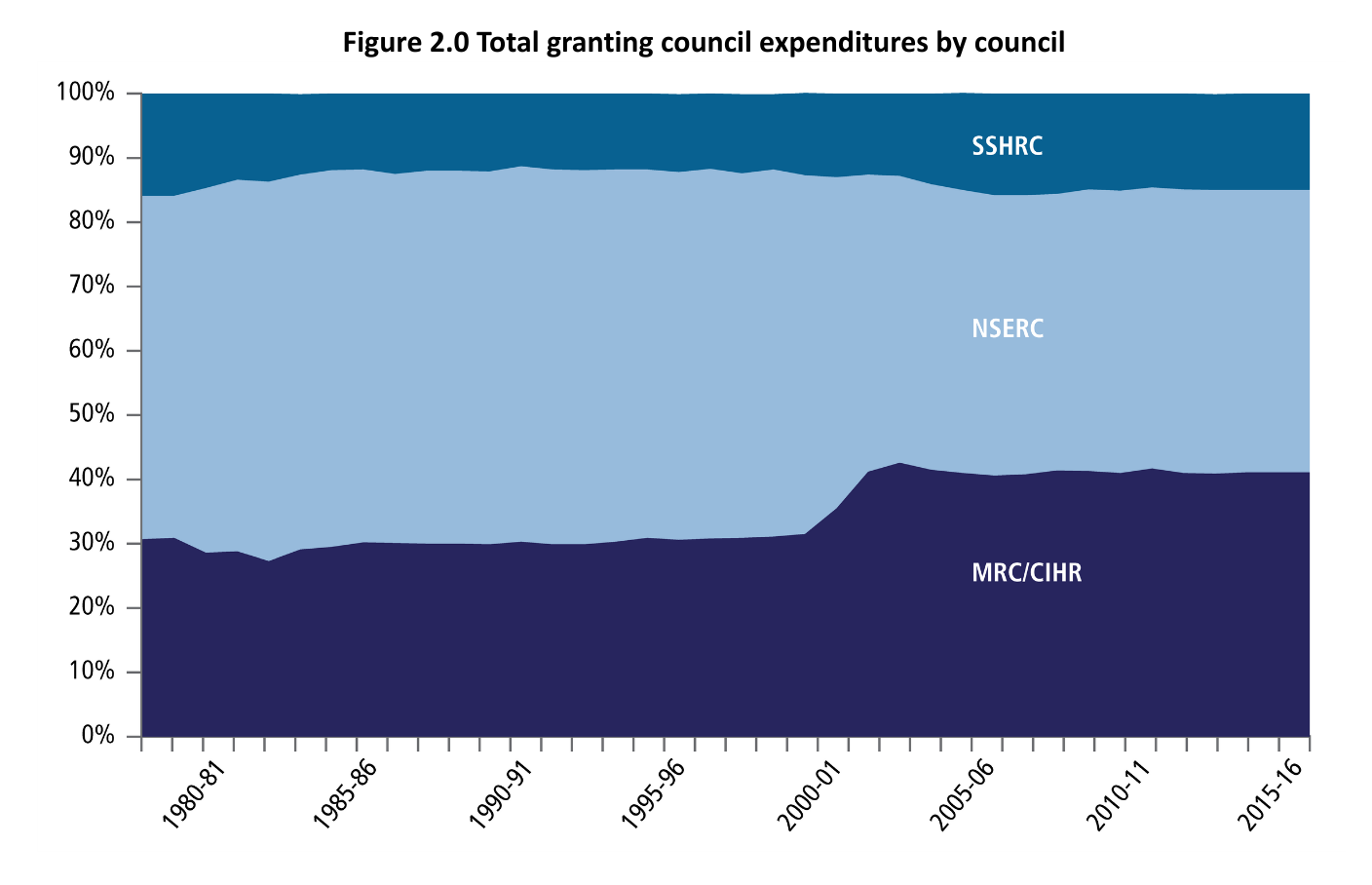
Note: Our analysis of research funding trends in this figure excludes the Research Support Fund (RSF) - previously the Indirect Costs Program (ICP) - since it does not support researchers directly. Rather, it provides funding directly to institutions to help defray the costs associated with managing research funding by the three granting councils (i.e. electricity and administrative support)
Source: ISED
 2. Position the HSS as core drivers of innovation
Through community-centred approaches, HSS experts provide essential insights into Canada’s most pressing challenges. These issues demand human-centred, values-driven approaches to advance meaningful, ethical innovation, and HSS disciplines must be integrated at every stage of Canada’s research and innovation agenda. As the federal government works to strengthen research and innovation in areas of national interest, HSS disciplines must be fully embedded in the process.
Currently, in fields such as AI and quantum technology, where advances are rapidly shaping daily life, little of Canada’s $2.4 billion in AI research funding is dedicated to understanding social implications. This “STEM-first, societal considerations-last” approach increases the risk of harm and missed opportunities. A telling example, Indigenous communities were not adequately consulted in the internet’s rollout, and still face disproportionate barriers due to this digital divide..
HSS disciplines are Canada’s largest source of post-secondary talent, training future public servants, innovators, policymakers, educators, and community leaders. HSS fields accounted for over 1.16 million students (more than half of all post-secondary enrollments) in 2021/2022, supported by the country’s largest faculty group. With such a critical role in shaping adaptable, ethical, and socially grounded solutions, these disciplines cannot be overlooked or underfunded.
Sustained investment ensures Canada can meet evolving challenges with innovation that serves the public good.

3. Invest in national open access infrastructure
Open access (OA) is foundational to Canada’s goal of making publicly funded research freely available worldwide. Despite policy commitments like the 2020 Roadmap for Open Science, researchers still face high publishing fees, limited infrastructure, and inequitable access. Early-career scholars, equity-deserving groups, and those publishing in French or Indigenous languages are most impacted by these challenges. For HSS scholars in particular, scholarly books and monographs remain central vehicles of research dissemination; yet they often are excluded from OA funding and policy frameworks. To meet its commitments, Canada must invest in a coordinated national OA funding and infrastructure strategy.
Without a dedicated OA stream for long-form scholarship, Canada risks leaving a critical gap in how its publicly funded research reaches the world. By lowering financial and technical barriers, national investment in OA will expand global access to Canadian scholarship and ensure publicly funded knowledge benefits all Canadians.
OA models need to resource community-led publishers, library-based platforms, and diamond OA initiatives. Yet, without adequate funding and infrastructure, OA publishing remains costly, fragmented, and inequitable .
Targeted support is needed for equity-deserving researchers, along with alignment with Indigenous data sovereignty principles and measures to increase the discoverability and impact of French-language research. These actions would fulfill recommendations from the House of Commons Standing Committee on Science and Research and ensure that Canadian knowledge systems reflect the country’s full diversity.

4. Increase dedicated support for Indigenous and French research
Indigenous communities continue to face disproportionate barriers to research funding and opportunities, and French-language research remains chronically under-supported in Canada. Recent federal investments, including $30 million over three years for Indigenous participation in research and new funding streams for French research, are important steps forward but to deliver lasting impact, these commitments must be implemented in full partnership with affected communities.
For Indigenous research, full collaboration with Inuit, Métis, and First Nations communities is essential to ensure funding aligns with their priorities and advances the Truth and Reconciliation Commission’s Calls to Action. Central to this work is upholding Indigenous data sovereignty, self-determination, and Indigenous-led approaches to education and research. Moving these funds forward without delay is critical to addressing historical inequities and building research systems that reflect Indigenous knowledge and values.
For French-language research, federal initiatives such as Canadian Heritage’s new Post-Secondary Sector and Scientific Knowledge in French Support Fund help address a long-standing gap in support for Francophone scholarship. As the federal government works to increase funding for French research, at least one-third of funding and opportunities should be dedicated to Francophone HSS researchers specifically as they play a vital role in preserving language and culture, strengthening democratic participation, and advancing social equity. Sustained investment will ensure both Indigenous and Francophone research can flourish and fully contribute to Canada’s research and innovation landscape.
Conclusion
The Federation calls on the Government of Canada to secure the essential building blocks of a thriving research and innovation ecosystem by:
- Following through on its 2024 investments in Canada’s next generation of researchers and addressing structural underfunding of HSS
- Committing to the meaningful involvement and support of HSS expertise in national research and innovation priorities
- Establishing a national, coordinated funding approach for OA
- Bolstering support for Indigenous research and French knowledge creation, and dissemination
With greater federal leadership and strengthened investment for HSS scholars, our country can become a global leader in the knowledge economy and secure a better future for all people in Canada.
Credits
- Figure 1.0 - Usher, A., & Balfour, J. (2024). The State of Postsecondary Education in Canada, 2024. Toronto: Higher Education Strategy Associates.
- Figure 2.0 - Investing in Canada’s Future: Strengthening the Foundations of Canadian Research. 2017. Canada’s Fundamental Science Review.