
About the author | About the book | Author's notes
"There is often concern about the verbal violence that disrupts public debates. This anthology shows that, throughout history, polemics have nonetheless served to defuse social tensions and foster a shift in attitudes."
About the author

Dominique Garand is a professor in the Department of Literary Studies at the Université du Québec à Montréal and co-director of the Interuniversity Research Center on Literature and Culture in Quebec (CRILCQ).
A specialist in polemical discourse, he has published several works on the subject.
About the book
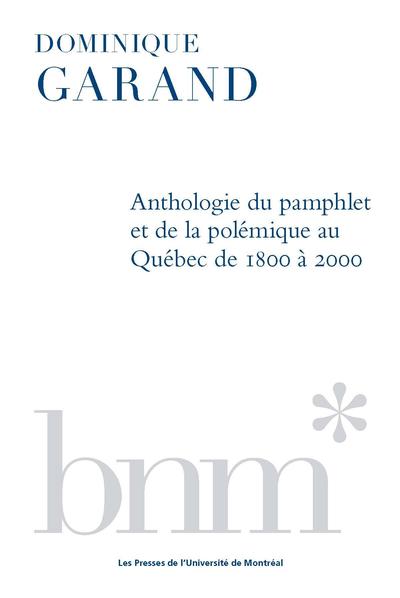 A persistent belief holds that Quebecers shy away from controversy: they are said to avoid it and prefer to fall in line behind a weak consensus. This book, however, demonstrates that the consistency and ubiquity of combative writing in Quebec are often underestimated. For two hundred years, verbal strategies have been deployed—ranging from subtle irony to caricature—to denounce, condemn, mock, and accuse. These clashes have left their mark on every sphere of society, in politics and religion, in customs and the arts, as well as in literature. Quebec’s history is also dotted with figures who specialized in invective: from Bibaud to Mouawad, including Buies, Fréchette, Tardivel, Barbeau, Grignon, Circé-Côté, Harvey, Ferron, Bourgault, Dubois, and Falardeau, we see this same drive to shake off inertia, to alert public opinion, and to lambast the agents of error and scandal. Others join the ranks, having participated in this endeavor on a more sporadic basis. Their styles and ideas vary, but they share the same conviction that one must never remain silent in the face of what is offensive!
Preceded by a substantial introduction to the realms of the pamphlet and polemic and a summary of the criteria guiding the selection of texts, the anthology traces the evolution of this two-century-long history by presenting a picture as fascinating as it is instructive of the written forms of violence and struggle.
“Preceded by a substantial introduction to the world of pamphlets and polemics in Quebec, the anthology traces the evolution of this genre of discourse and paints a picture of the written forms of violence and struggle that is as fascinating as it is enlightening.”
There is often concern about the verbal violence that disrupts public debates. This anthology shows that, throughout history, polemics have nonetheless served to defuse social tensions and foster a shift in attitudes.